
Peptides raise a lot of questions for people new to laboratory science, and getting a clear answer matters before diving into the literature. In simple terms, a peptide is a short chain formed when amino acids link together, and how do peptides work comes down to the sequence of that chain and the target it recognizes. Some peptides occur naturally as signaling molecules, while others are produced in a laboratory as research compounds. This guide breaks down what are peptides, their biology, peptide mechanism of action, and peptide signaling pathways in plain language, so researchers and students have a clear, science-based starting point.
Peptides Explained: The Basic Building Blocks
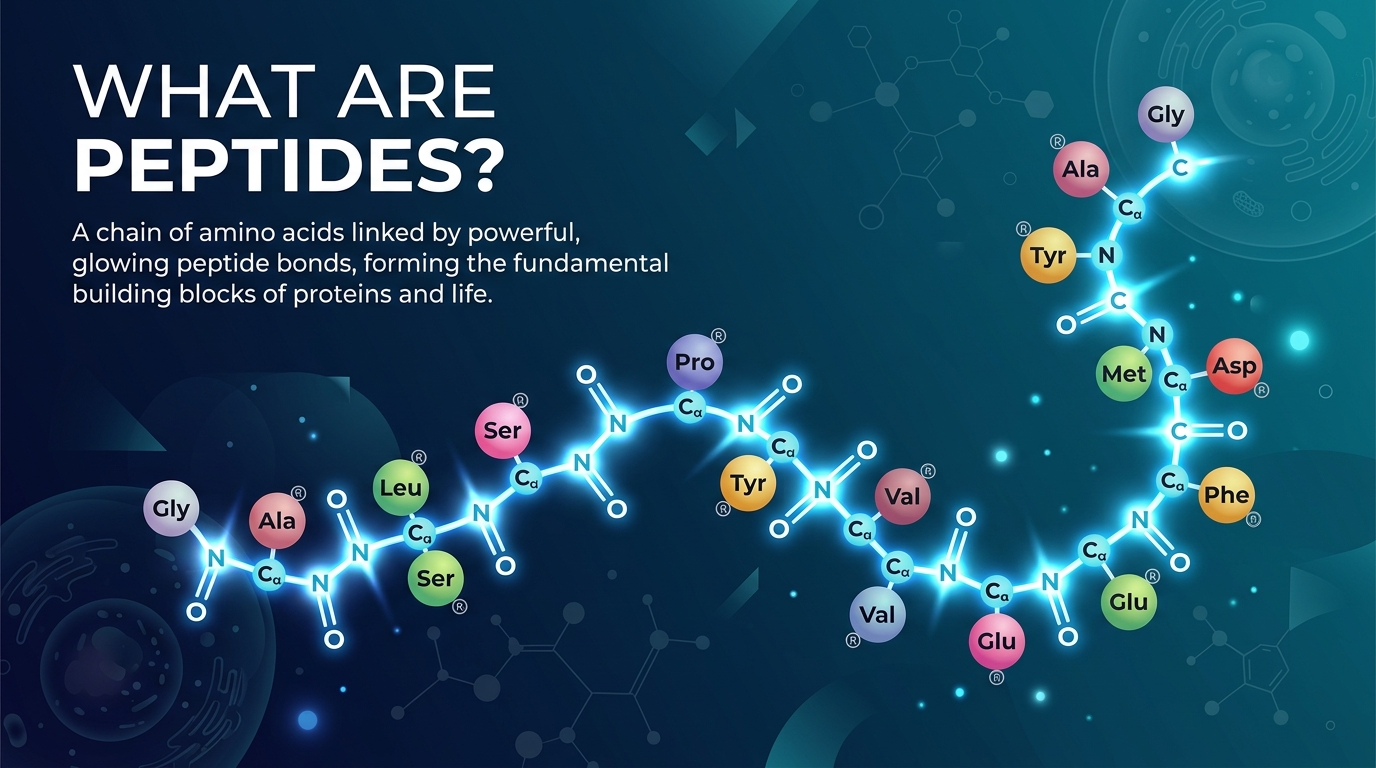
A peptide is best understood as a molecule built from amino-acid units joined together in a chain. This raises a common question, what is a peptide bond? A peptide bond is the chemical link formed when the carboxyl group of one amino-acid unit reacts with the amino group of another, releasing a water molecule in the process. Chains grow one link at a time, and once a chain becomes long enough, biochemists classify it as a polypeptide rather than a short peptide. This is the core of the peptide definition used across biochemistry, and it also underlies every peptide function discussed later in this guide.
Why Sequence Shapes Peptide Behavior
Peptide structure and function are closely linked, because the order of amino-acid units decides how a molecule folds and which conformation it adopts. That order is called the amino acid sequence, and it shapes both molecular structure and molecular conformation at the same time. Even a single substitution can change how a molecule interacts with a target, altering its stability, its selectivity, and its overall biological activity. Researchers who study peptide sequence and function together tend to get a far more accurate picture than those who look at either factor alone.
What Happens When a Peptide Reaches Its Target
So how peptides work in the body starts with recognition. A peptide reaches a tissue, locks onto a specific molecular target, and triggers a response. That target is often a surface protein sitting on a cell membrane, though some peptides act on a catalytic protein or another type of protein instead. This triggers intracellular signaling, which can involve a second messenger, and the overall chain of events is generally described as signal transduction. This is the essence of peptide function at a cellular level.
How Peptides Recognize Their Targets
Peptide receptors are built to recognize a specific ligand, and peptide receptor binding depends on how well the shapes of the two molecules match. Many hormone-like peptides interact with a GPCR, a membrane-bound signaling protein class, and this interaction can lead to receptor activation or, in other cases, blockade. Depending on the molecule, a peptide may switch its target on, or act as an antagonist that blocks activation by another molecule instead. Some peptides do neither and instead work through enzyme inhibition, slowing a specific catalytic protein rather than triggering activation at all. This is one reason peptide function cannot be reduced to a single mechanism.
How Cell Signaling Carries a Peptide’s Message
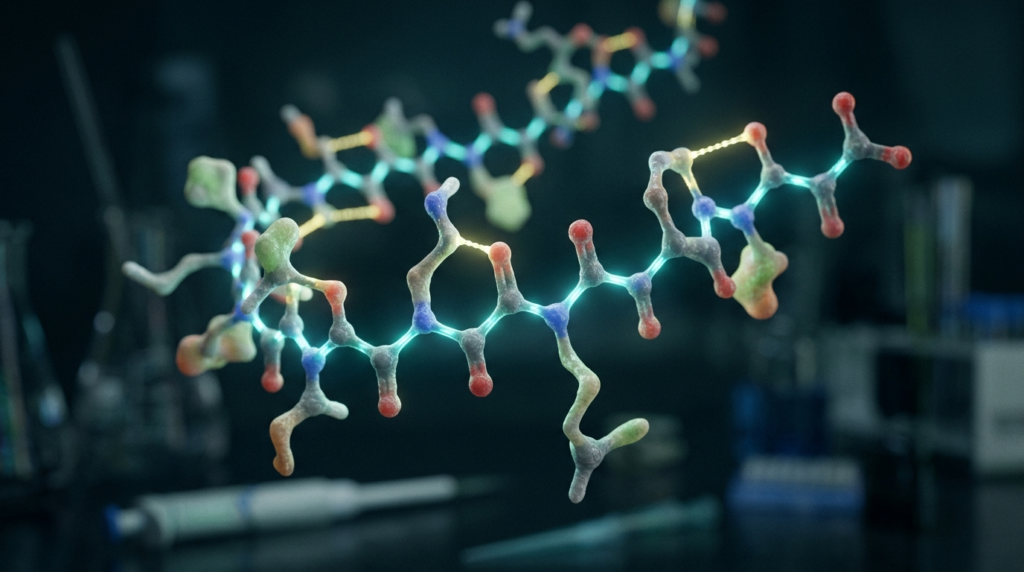
This process is a form of biological signaling that lets one cell communicate with another using chemical signals passed from molecule to molecule. Once a target is engaged, the resulting cellular response depends on the cell type, the amount of molecule present, and how long the interaction lasts. This context-dependent behavior explains why the same peptide can produce different outcomes in different tissues, and it is a central theme in this area of study today.
Natural Peptides and Their Everyday Roles
These natural molecules are not a laboratory invention. The body produces a wide range of hormone-based peptides that regulate everyday physiology, including insulin, glucagon, oxytocin, vasopressin, and parathyroid hormone. Each of these has a distinct peptide function in the body, from managing blood sugar to supporting fluid balance and bone metabolism. Studying these molecules gives scientists a template for designing manufactured versions with related, modified, or entirely novel activity.
Lab-Made Variants and Structural Tweaks
Synthetic peptides are produced chemically to reproduce a natural sequence, or to create peptide analogues with altered properties. Scientists introduce peptide modifications to change how selectively a molecule binds its target, extend duration of action, or improve overall stability. A lab-made peptide does not have to be identical to a natural molecule to retain a meaningful biological effect, which is why this kind of design stays such an active part of peptide research today.
What Makes a Peptide a Research Peptide
A research peptide is a compound manufactured and sold strictly for laboratory investigation, not for human or veterinary use. Many suppliers label these products RUO, and people often ask what does RUO mean in peptides. RUO stands for Research Use Only, meaning the material is intended for qualified researchers working in a controlled laboratory setting rather than for consumption. When people search what are research peptides, they are usually looking for research grade peptides that come with proper analytical documentation, including verified sequence data and batch-specific testing. Genuine research use only peptides should never be marketed with instructions for personal use, and reputable suppliers such as Global Peptides are transparent that these compounds exist purely to support scientific study.
How Research Peptides Are Made and Verified
Most research compounds are produced through solid-phase peptide synthesis, where a growing peptide amino acid chain is built one residue at a time on a solid support. Once the process is complete, peptide purification removes byproducts and incomplete chains so that only the intended molecule remains. Peptide characterization then confirms identity and purity using analytical tools such as HPLC and mass spectrometry. This combination of building, cleaning, and verifying a molecule is what separates properly documented compounds from poorly sourced material, and it is a core part of peptide function verification before any compound is released for study.
Understanding Peptide Degradation, Stability, and Half-Life
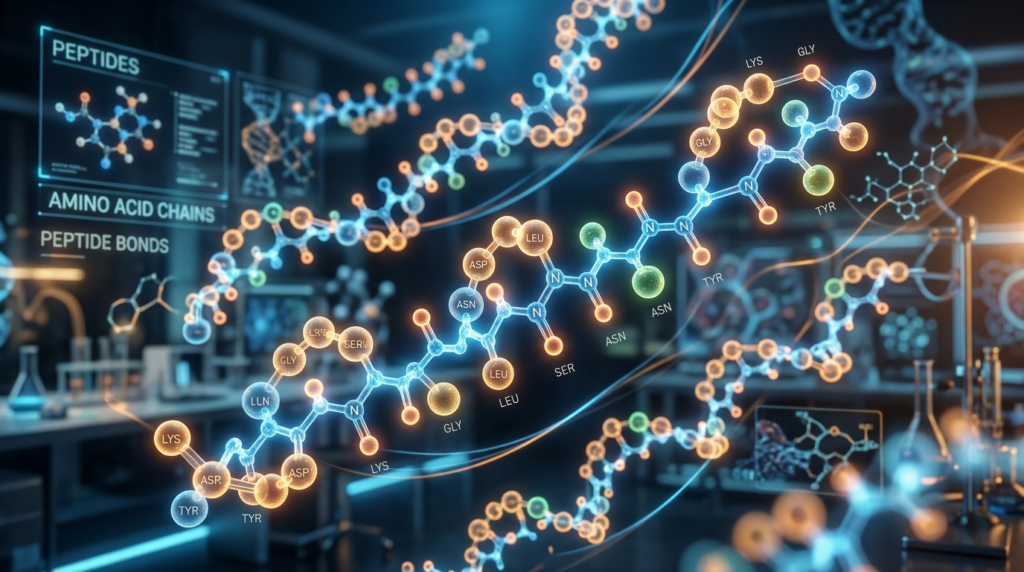
Peptide stability is one of the biggest challenges in this field. Biological fluids can break peptide bonds through proteolysis, a process also known as enzymatic degradation, which limits how long a molecule remains active. This directly affects peptide half-life, since a molecule that breaks down quickly is cleared from a system faster than one built to resist breakdown. Metabolic clearance, along with peptide absorption and peptide metabolism, together determine the pharmacokinetics of a given compound, while pharmacodynamics describes what it actually does once it reaches its target. Poor peptide bioavailability, particularly after oral exposure, remains one of the central formulation challenges researchers continue to work on, alongside peptide delivery methods designed to protect a molecule long enough to reach its intended site of action.
Comparing Peptides and Proteins
People frequently ask about the peptide vs protein difference, and the short answer is chain length and structural complexity. The difference between peptides and proteins is not an exact cutoff, but proteins are generally longer, more folded, and more structurally complex than peptides. Both are built from the same building blocks and both use the same type of chemical linkage, yet their roles in a biological system can look quite different.
Comparing Peptides and Steroids
Peptide vs steroids is a separate comparison researchers ask about often, since the two are frequently confused despite being chemically unrelated. The difference between peptides and steroids comes down to molecular class: peptides are chains that typically act on a surface protein, while steroids are lipid-based molecules that often act inside a cell instead. The peptides vs steroids vs proteins comparison table below summarizes these distinctions at a glance.
| Category | Building Block | Typical Site of Action | Common Example |
| Peptides | Amino-acid chain | Cell-surface target | GLP-1 |
| Proteins | Amino-acid chain | Structural or catalytic | Antibodies |
| Steroids | Lipid-derived | Inside the cell | Cortisol |
Why This Field Keeps Growing
This corner of pharmacology continues to expand because these molecules sit between traditional small-molecule drugs and larger biologic therapies, combining useful features of both. Ongoing work focuses on improving receptor selectivity, extending half-life, and refining delivery systems, all while maintaining rigorous documentation standards. Any organization producing well-documented compounds should be able to demonstrate proper characterization data, consistent manufacturing practices, and clear labeling that the material is intended strictly for laboratory use.
A Note on Responsible Research Use
Global Peptides supplies research peptides exclusively for laboratory and scientific investigation. Nothing on this page should be interpreted as guidance for human or animal use, and researchers are expected to follow their own institution’s protocols and applicable regulations. For those exploring reputable suppliers, checking for batch-specific certificates of analysis, clear RUO labeling, and transparent sourcing is a reasonable starting point before selecting a supplier for a project.
Final Overview and Next Steps
Peptides are far more nuanced than a single definition can capture, and understanding peptide function requires looking at sequence, structure, target interaction, and metabolism together rather than in isolation.
For laboratories, and researchers who want to explore verified, well-documented compounds, Global Peptides maintains a catalogue built around transparency and analytical rigor. Visit the link below to learn more about our approach to research-grade materials, or head straight to the shop to review available research peptides and their accompanying documentation before starting your next project.
Frequently Asked Questions
How do peptides work in the body?
A peptide travels to a tissue, recognizes a matching target, and triggers a response that changes cell behavior. The exact outcome depends on the molecule’s sequence, the target involved, and the tissue where the interaction takes place.
How do peptides affect cells?
Once a peptide binds its target, it can switch a process on or off, influence a catalytic protein, or trigger a signaling cascade that leads to changes in gene expression, secretion, or metabolism, depending on the cell type involved.
How do peptide hormones work?
These natural signaling molecules are released into circulation and travel to distant tissues, where they bind matching targets and adjust processes such as blood sugar regulation, fluid balance, or growth signaling, depending on which one is involved.
What are peptides used for?
In research settings, these molecules are studied for their roles in metabolism, cellular communication, immune function, and target-based pharmacology, helping scientists understand disease mechanisms and potential therapeutic pathways.
Why do peptides have a short half-life?
Many peptides are broken down quickly by biological fluids, a process that limits how long they remain active before being cleared from the system.
Are research peptides the same as peptide medicines?
No. Research peptides are intended strictly for laboratory investigation and are not approved or labeled for human or animal treatment, while peptide medicines have gone through formal regulatory evaluation for a specific medical use.